



Why Should Electrical Planning Begin Before the Budget Is Finalized?
Electrical projects may require inspections, engineering, product selection, permits, equipment lead times and coordination with residents or tenants.
Waiting until equipment fails can limit available options and turn a planned improvement into an emergency expense. Starting early allows the management team and board to separate projects into three categories:
- Immediate life-safety and code requirements
- Aging equipment and recurring maintenance problems
- Future improvements and capacity needs
A professional property walk-through can help identify which items belong in each category.
1. Review Safety and Compliance Requirements
Begin with projects that could affect occupant safety, code compliance or required inspections.
Review:
- Open electrical inspection findings
- Outstanding code violations or corrections
- Upcoming electrical recertification deadlines
- Emergency and exit lighting
- Damaged wiring, panels or electrical enclosures
- Previously identified grounding or bonding concerns
Keep inspection reports, photographs, repair records and municipal correspondence together. These documents can help contractors develop an accurate scope of work and give the board better information when reviewing the project.
Requirements differ by building type and jurisdiction. Confirm applicable deadlines and compliance requirements with the appropriate local authority and qualified professionals.
Learn more about Electryfy’s electrical recertification services.
2. Evaluate the Condition of Electrical Equipment
Electrical equipment can continue operating while developing conditions that are not obvious during a basic visual inspection.
Ask the following questions:
- How old are the property’s electrical panels and breakers?
- Are breakers tripping repeatedly?
- Is there visible corrosion, moisture or heat damage?
- Are electrical rooms clean, accessible and properly labeled?
- Have residents, tenants or maintenance personnel reported recurring problems?
- Are replacement parts readily available for the existing equipment?
A preventive maintenance assessment may include visual inspections, documentation reviews, testing and infrared thermography. Infrared inspections can help identify abnormal heat patterns that may require additional investigation.
The goal is to find developing concerns before they become emergency outages, larger repairs or disruptions to property operations.
3. Plan for Future Electrical Capacity
Buildings are using more electrical equipment than they did when many existing systems were designed.
Future projects may include:
- Electric vehicle charging stations
- HVAC replacements or expansions
- Access-control and security systems
- Pumps and mechanical equipment
- Amenity and common-area improvements
- Additional exterior lighting
- Building automation and lighting controls
Before approving equipment that creates a new electrical load, determine whether the existing service, panels, feeders and distribution equipment can support it.
A capacity review can help the property avoid purchasing equipment before understanding the electrical infrastructure required to operate it.
If upgrades are necessary, the board can decide whether to complete them immediately, include them in the 2027 budget or develop a phased improvement plan.
4. Inspect Parking, Garage and Common-Area Lighting
Exterior and common-area lighting affects visibility, security, energy use, maintenance requirements and the overall appearance of a property.
Conduct an after-dark inspection of:
- Parking lots
- Parking garages
- Building entrances
- Walkways
- Stairwells
- Loading and service areas
- Amenity spaces
- Monument and directional signs
Look for failed fixtures, inconsistent illumination, dark areas, damaged poles, cycling lamps and landscaping that blocks light.
Properties with older fixtures may benefit from LED lighting and updated controls. When evaluating an upgrade, consider more than the initial installation price. Review energy use, expected equipment life, maintenance requirements, warranties and lighting performance.
5. Test Timers, Photocells and Lighting Controls
Lighting controls are frequently overlooked during budget planning.
A timer with an incorrect schedule or a failed photocell can cause lights to remain on during the day or turn off when illumination is still needed. These problems can increase energy use and create unnecessary service calls.
Include the following in the property review:
- Mechanical and digital timers
- Photocells
- Occupancy sensors
- Lighting contactors
- Automated schedules
- Manual override settings
- Daylight-saving time adjustments
Updating fixtures without reviewing the controls may leave part of the underlying problem unresolved.
6. Prepare for Storms and Power Interruptions
South Florida properties should include electrical resilience in annual budget discussions.
Review:
- Surge-protection equipment
- Emergency and exit lighting
- Backup battery fixtures
- Generators and transfer equipment
- Critical and emergency circuits
- Exterior electrical enclosures
- Weather-exposed wiring and connections
- Systems that must remain operational during an outage
Management should know which building systems receive backup power and which do not. Any proposed additions to emergency or generator-backed circuits should be professionally evaluated before new loads are connected.
Storm preparation is not limited to installing equipment. Testing, maintenance, documentation and staff awareness are also important parts of the plan.
7. Prepare Clear Scopes and RFPs
Contractor proposals are easier to compare when every bidder receives the same project information.
A useful scope should define:
- Existing conditions
- Required repairs or improvements
- Equipment and performance expectations
- Engineering responsibilities
- Permit requirements
- Testing and closeout documentation
- Work-hour or access limitations
- Required shutdowns
- Warranty expectations
- Project schedule
Avoid making a decision based only on the lowest total price. Review qualifications, licensing, relevant experience, included work, exclusions, equipment quality, warranty coverage and project-management approach.
8. Consider the Complete Project Cost
A realistic electrical budget may need to include more than labor and materials.
Depending on the project, account for:
- Engineering and design
- Permit and inspection fees
- Utility coordination
- Equipment lead times
- Temporary power or lighting
- Lift or equipment rental
- Concrete, painting or restoration work
- Resident and tenant coordination
- Testing and commissioning
- Contingency funds
Understanding the complete project requirements reduces the likelihood of discovering major costs after approval.
9. Prioritize Projects for Board Review
Present projects in a format that makes decisions easier.
For each proposed project, include:
- A description of the existing condition
- Photographs
- The reason the work is recommended
- Safety or compliance implications
- Preliminary scope
- Estimated budget
- Proposed schedule
- Operational impact
- Expected useful life
- Warranty information
- Potential energy or maintenance savings
Organize the recommendations by priority.
Priority 1: Life Safety and Code
Address active hazards, code violations, failed emergency systems and urgent compliance requirements.
Priority 2: Aging Equipment
Plan for equipment with recurring failures, corrosion, limited parts availability or declining reliability.
Priority 3: Future Improvements
Evaluate capacity expansion, EV charging, smart controls, LED upgrades and other long-term property improvements.
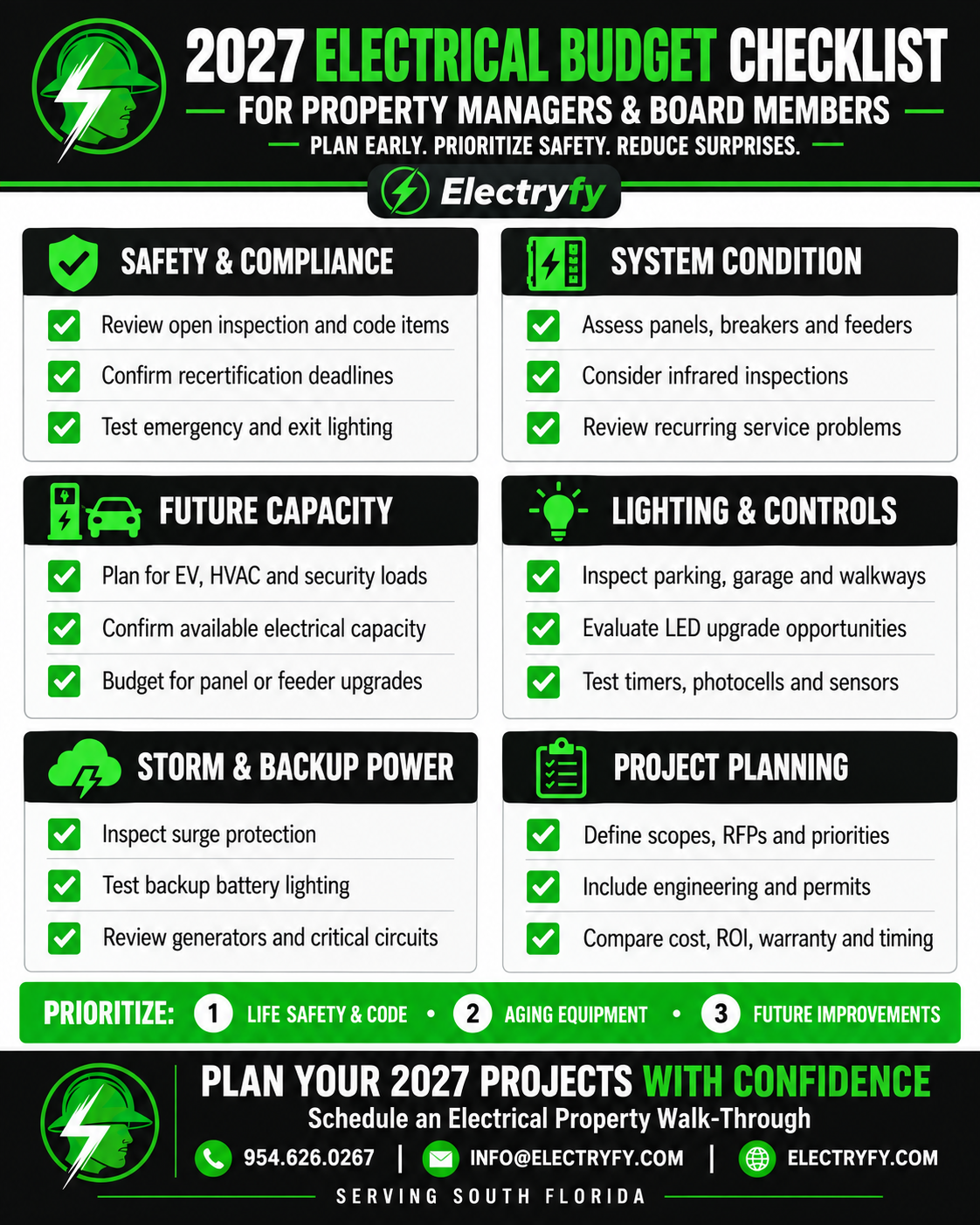
2027 Electrical Budget Checklist
Before approving the electrical portion of the property budget, confirm that the board has reviewed:
- Safety and compliance requirements
- Electrical recertification deadlines
- Panels, breakers and distribution equipment
- Infrared inspection recommendations
- Recurring electrical service problems
- Future EV, HVAC and security-system loads
- Parking, garage and walkway lighting
- LED upgrade opportunities
- Timers, photocells and sensors
- Surge protection
- Emergency battery lighting
- Generators and critical circuits
- Project scopes and RFP requirements
- Engineering and permitting costs
- Warranties, schedules and contingencies
Frequently Asked Questions
When should a property begin planning its 2027 electrical budget?
Planning should begin several months before the budget is finalized. Projects involving engineering, permits, specialized equipment or board approval may require additional time.
Which electrical projects should receive the highest priority?
Life-safety concerns, active failures, code violations and required compliance work should generally be reviewed first. A qualified professional should evaluate the conditions and recommend the appropriate response.
Can an electrical contractor help prepare an RFP?
An electrical assessment can document existing conditions and help define the proposed scope. Complex projects may also require professional engineering before a final bid package is prepared.
Should an older panel be replaced simply because of its age?
Age is only one factor. Condition, capacity, maintenance history, parts availability, observed damage and the property’s future requirements should also be evaluated.
Why should lighting be included in the capital budget?
Lighting upgrades may improve visibility, reduce maintenance, lower energy use and enhance the appearance of common areas. Larger upgrades may be better treated as planned capital improvements rather than repeated fixture-by-fixture repairs.
What should a board request before approving an electrical project?
Request a defined scope, contractor credentials, pricing, exclusions, project schedule, permit responsibilities, equipment information and warranty terms.
Plan Your 2027 Projects With Confidence
Electryfy helps property managers, condominium and HOA boards, commercial property owners and facility teams evaluate electrical conditions and plan upcoming improvements.
Our team can perform an on-site property walk-through and help identify:
- Immediate safety and compliance needs
- Aging equipment and maintenance priorities
- Lighting and control improvements
- Future electrical-capacity requirements
- Storm and emergency-power considerations
- Projects to include in the upcoming capital budget
Plan early, prioritize safety and reduce unexpected budget surprises.
Call 954-626-0267, email info@electryfy.com or visit www.electryfy.com to schedule an electrical property walk-through.


