
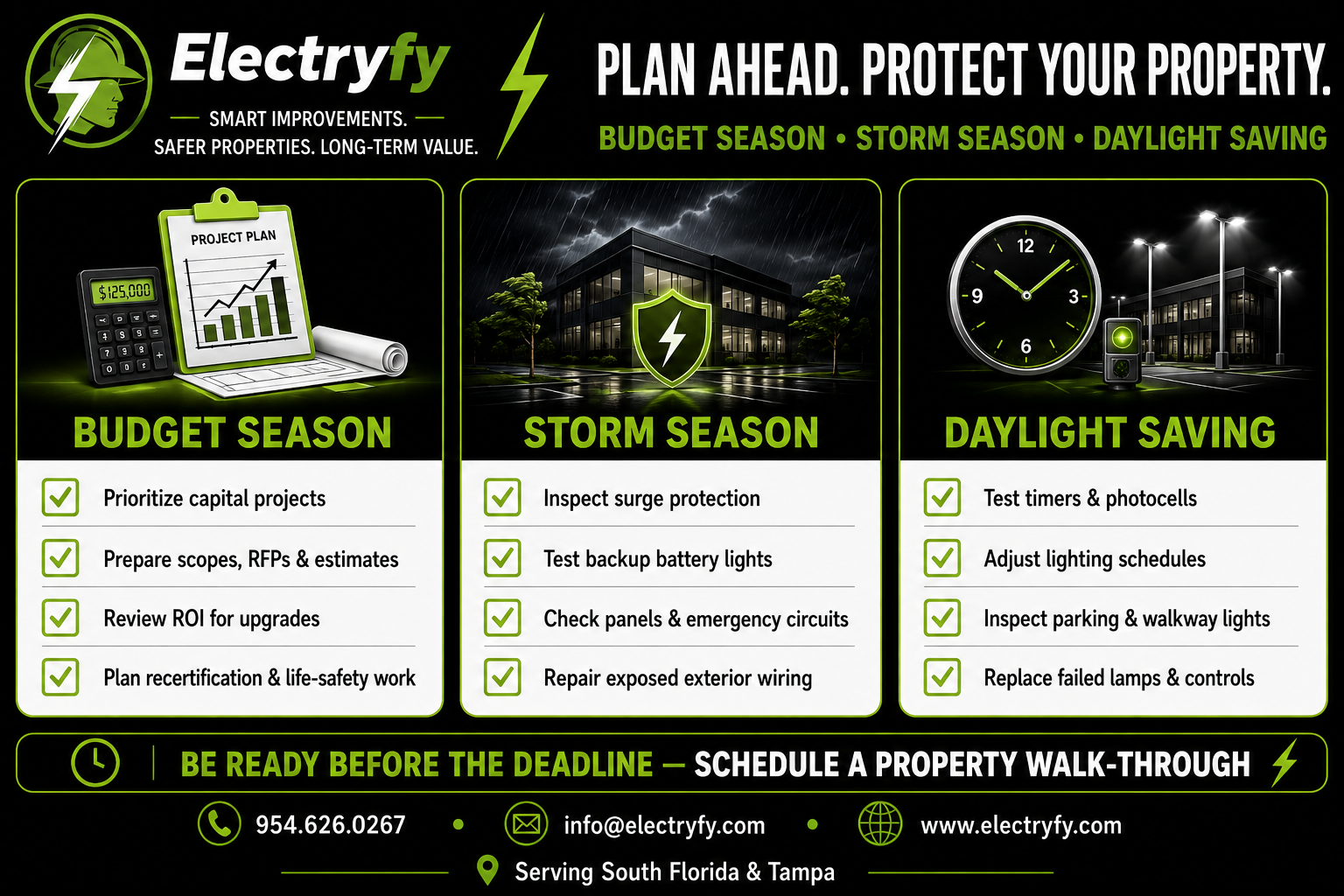

Electrical Planning Checklist for Property Managers: Budget, Storm and Daylight Saving Preparation
Property managers and association board members are responsible for keeping their buildings safe, operational, compliant and financially prepared. Three recurring events—budget season, Florida’s storm season and daylight saving time—create an ideal opportunity to evaluate a property’s electrical systems.
A proactive electrical property assessment can help management teams identify safety concerns, prioritize capital improvements, develop realistic budgets and reduce the likelihood of last-minute repairs.
Use this checklist to start planning with your board, management team, engineer and licensed electrical contractor.
Why Should Electrical Planning Begin Before Budget Season?
Electrical projects often require more than a preliminary price. Depending on the project, the planning process may include an on-site assessment, engineering, specifications, permits, product selection and coordination with the local authority having jurisdiction.
Starting early gives property managers and boards time to:
- Identify immediate safety and compliance concerns
- Separate maintenance expenses from capital improvements
- Establish priorities based on urgency and property needs
- Prepare clear scopes of work and RFPs
- Obtain realistic project estimates
- Evaluate the potential return on investment
- Coordinate project timing with residents, tenants and vendors
Early planning also gives decision-makers better information before budgets are approved or special assessments are considered.
Budget Season Electrical Checklist
1. Identify and Prioritize Capital Projects
Walk the property and document aging, damaged or unreliable electrical systems. Potential projects may include electrical panel replacements, distribution-system repairs, LED lighting upgrades, emergency lighting, exterior lighting and electrical recertification corrections.
Classify each item as:
- Immediate life-safety or compliance work
- Preventive maintenance
- Short-term capital improvement
- Long-term infrastructure planning
This helps boards understand which projects are urgent and which can be scheduled over several budget cycles.
2. Prepare Clear Project Scopes and RFPs
A clearly defined scope of work makes contractor proposals easier to compare. It can also reduce change orders and confusion after a project begins.
An electrical assessment or hard audit can help document existing conditions, identify potential deficiencies and establish the foundation for an RFP or request for quotations.
For complex projects, the scope may need to address engineering, permitting, equipment specifications, installation, testing and closeout documentation.
3. Evaluate ROI and Long-Term Costs
The lowest initial price is not always the lowest long-term cost. When reviewing lighting or electrical improvements, consider:
- Expected energy savings
- Maintenance and replacement costs
- Equipment life expectancy
- Warranty coverage
- Potential utility incentives
- Improved safety and visibility
- Future electrical capacity requirements
LED lighting and lighting-control projects, for example, may offer energy and maintenance savings while improving visibility in parking lots, garages, walkways and common areas.
4. Plan for Recertification and Life-Safety Improvements
Buildings approaching an electrical recertification milestone should begin preparing well before the applicable deadline. Requirements vary by building type and jurisdiction, so property managers should confirm the rules that apply to their property.
Planning may involve inspections, infrared thermography, engineering support, electrical repairs, emergency and exit lighting corrections, permit coordination and compliance documentation.
Learn more about Electryfy’s electrical recertification services.
How Should Commercial Properties Prepare Electrically for Storm Season?
Storm preparation should include more than securing outdoor furniture and checking the roof. Electrical systems support a property’s lighting, communications, access controls, pumps, elevators and other essential operations.
A licensed electrical contractor can help identify vulnerable equipment and recommend improvements based on the property’s electrical system and operational needs.
Storm Season Electrical Checklist
1. Inspect Surge Protection
Power disturbances can affect sensitive electrical equipment and building systems. Property managers should determine whether surge-protection devices are installed, properly sized and in serviceable condition.
Surge protection should be evaluated as part of a coordinated electrical strategy rather than treated as a universal guarantee against every storm-related event.
2. Test Emergency and Backup Battery Lights
Emergency and exit lights should operate when normal power is interrupted. Test battery-backed fixtures and document units that are damaged, dim, outdated or unable to remain illuminated for the required duration.
Include parking garages, stairwells, corridors, electrical rooms, mechanical rooms and other critical common areas in the review.
3. Check Electrical Panels and Emergency Circuits
Look for visible corrosion, water intrusion, overheating, damaged labels, missing covers or other signs that require professional evaluation.
Electrical panels should remain accessible and clearly identified. Do not open, test or repair energized equipment unless the work is performed by qualified personnel.
4. Inspect Exterior Electrical Equipment
Exterior wiring, junction boxes, lighting fixtures, poles, receptacles and controls are exposed to rain, wind, heat, salt air and moisture.
Before storm season, repair damaged enclosures, loose components, exposed wiring and other visible deficiencies. Property teams should also confirm which exterior systems need to remain operational following a power interruption.
5. Review Backup-Power Priorities
Document the systems that are connected to generators, batteries or other backup-power sources. Make sure staff understands which loads are supported and which are not.
If the property’s emergency-power requirements have changed, consult the appropriate electrical and engineering professionals before adding new loads.
Why Does Daylight Saving Time Affect Property Lighting?
Seasonal time changes can leave exterior lights operating at the wrong hours. A timer that has not been adjusted may turn lights on too late, turn them off too early or waste energy during daylight.
This can affect parking lots, garages, walkways, entrances, monument signs and common areas.
Daylight Saving Electrical Checklist
1. Test Timers and Photocells
Verify that timers display the correct time and that programmed schedules match current operating hours. Check photocells for dirt, damage, obstructions or nearby artificial light that may interfere with proper operation.
2. Adjust Exterior Lighting Schedules
Update schedules for earlier or later sunsets, seasonal operating hours and changes in property use. Confirm that override settings have not been left active after maintenance or special events.
3. Inspect Parking and Walkway Lighting
Perform the inspection after dark whenever possible. Look for failed fixtures, dark areas, cycling lamps, inconsistent color, damaged poles and landscaping that blocks illumination.
Documenting conditions with photographs can help management teams explain repair priorities to boards and contractors.
4. Replace Failed Lamps and Controls
One failed component can sometimes indicate a broader maintenance issue. Ask the contractor to evaluate the fixture, driver, ballast, wiring, photocell or timer instead of assuming that only the lamp needs replacement.
A Practical Seasonal Planning Schedule
Property managers can organize these responsibilities into a repeatable annual process:
- Before budget meetings: Complete a property walk-through, identify projects and obtain planning-level estimates.
- Before storm season: Inspect surge protection, emergency lighting, exterior equipment and backup-power priorities.
- Before daylight saving changes: Test timers, photocells and exterior lighting schedules.
- Before recertification deadlines: Confirm jurisdictional requirements and begin inspections, engineering and corrective work early.
Keep photographs, inspection reports, estimates, warranties and repair records in one accessible location. Good documentation makes future budgeting and board decision-making easier.
Frequently Asked Questions
When should a property manager start planning electrical capital projects?
Planning should begin before the annual budget is finalized. Larger projects may require assessments, engineering, permits, equipment lead time and board approval, so additional preparation time may be necessary.
What electrical items should be checked before Florida’s storm season?
Key items include surge protection, emergency and exit lighting, backup batteries, electrical panels, emergency circuits, exterior wiring, lighting controls and supported backup-power loads.
Why should timers and photocells be inspected around daylight saving time?
Time changes and shifting sunset hours can cause exterior lights to operate at incorrect times. Testing the controls helps maintain proper illumination and avoid unnecessary daytime energy use.
Can an electrical assessment help prepare an RFP?
Yes. A detailed assessment can document existing conditions and help define the project scope, required corrections and technical considerations that contractors should address in their proposals.
How can a condominium board prepare for electrical recertification?
The board should confirm the applicable deadline and requirements, gather previous reports, schedule a professional assessment and begin budgeting for inspections, engineering and corrective work. Requirements vary by jurisdiction and property type.
Who should perform commercial electrical inspections and repairs?
Inspections, testing and repairs involving commercial electrical systems should be handled by appropriately licensed and qualified professionals.
Schedule an Electrical Property Walk-Through
Electryfy works with property managers, condominium and HOA boards, commercial property owners and facility teams throughout Miami-Dade, Broward and Palm Beach counties.
Our team can help evaluate existing electrical conditions, identify project priorities and prepare scopes, estimates and recommendations for budget planning, storm preparation, lighting maintenance and recertification work.
Plan ahead before the deadlines arrive.
Call Electryfy at 954-626-0267, email info@electryfy.com or visit www.electryfy.com to schedule a property walk-through.


