

When daylight saving time ends, earlier evening darkness can reveal lighting problems that were less noticeable during summer. For Florida property managers, condominium and HOA boards, and commercial facility teams, the seasonal time change is a useful reminder to review exterior lighting and electrical maintenance.
Start with five priorities: verify timers and photocells, document damaged wiring and enclosures, identify failed lighting components, evaluate compatible LED upgrades, and review fuses and surge protection. An after-dark walk-through helps show how these systems perform when residents, tenants and visitors need them.
Safety first: This checklist is for planning and documenting maintenance, not DIY electrical repairs. Use a licensed electrical contractor for electrical testing, repairs and upgrades. Qualified personnel should de-energize equipment, follow applicable lockout/tagout procedures and verify the absence of voltage before work. Never touch damaged wiring or open energized electrical enclosures.
Download the Daylight Savings Checklist
Use this checklist nationwide as a starting point for seasonal lighting maintenance, whether or not your location observes daylight saving time. Local codes, environmental conditions and property requirements still apply. Save it for your next property walk-through or maintenance meeting. The five sections below explain what to look for and what to discuss with your electrical contractor.
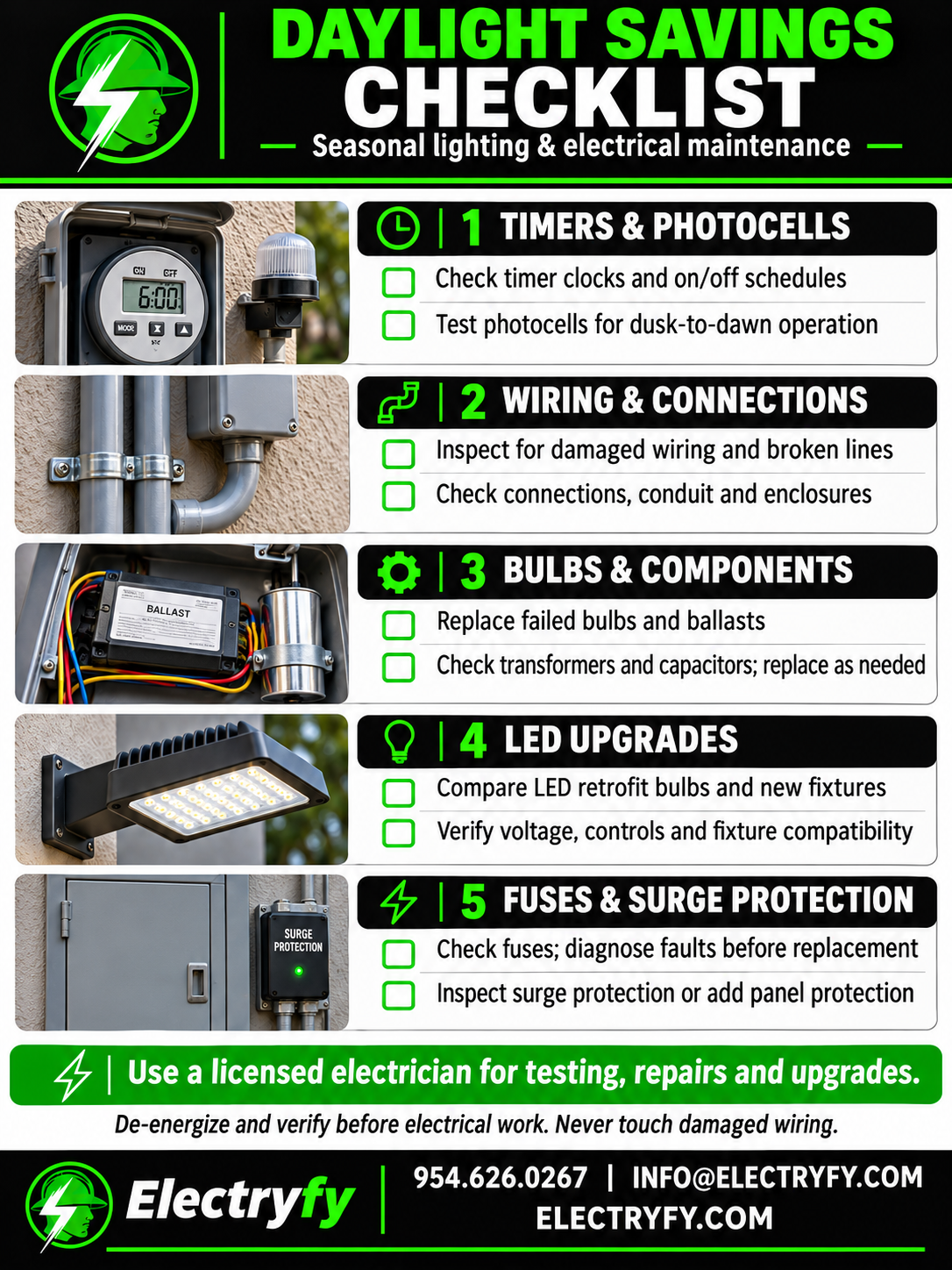
Download the Electryfy Daylight Savings Checklist (PNG)
The link opens the full-size image. Use your browser’s save-image option to keep a copy.
1. Check Timers, Photocells and Lighting Schedules
Verify that exterior lighting turns on before it is needed and stays on for the property’s required operating hours. Check parking areas, entrances, walkways, garages, signs and shared amenities after dark.
- Confirm the timer’s displayed time, day and programmed on/off schedule.
- Check daylight-saving settings before manually changing a digital clock. Some controls adjust automatically.
- For astronomical timers, verify the location, time zone and sunrise/sunset offsets.
- Review manual overrides, holiday schedules and settings that may have changed after a power interruption.
- Document lights that remain on in daylight, turn on too late, or shut off too early.
Photocells respond to ambient light, not the clock. They do not normally need a one-hour adjustment when daylight saving time changes. A qualified technician should check placement, shading, contamination, nearby artificial light and control operation if the lights switch at the wrong time. Allow for the device’s normal switching delay during testing.
2. Inspect Wiring, Connections, Conduit and Enclosures
From a safe distance, note cracked conduit, loose or missing covers, corrosion, damaged poles, exposed wiring and signs of water entering equipment. Outdoor electrical systems face weather, irrigation, landscaping activity and accidental impact throughout the year.
Record the location and photograph visible damage only when it is safe to do so. Keep people away from damaged equipment and arrange professional assessment. Do not handle broken lines, remove covers or attempt to tighten electrical connections.
A licensed electrical contractor can evaluate wiring integrity, connections, grounding and bonding, enclosure condition and the repairs required. Water-damaged equipment needs professional evaluation before it is returned to service.
3. Diagnose Failed Bulbs and Lighting Components
A dark or flickering fixture does not always need only a new bulb. The cause may involve the lamp, socket, ballast, LED driver, controls, supply wiring or another component.
- List fixtures that are dark, flickering, cycling on and off, or noticeably different in brightness.
- Ask the contractor to identify the cause before replacing parts.
- Confirm replacement lamps and components match the fixture’s electrical ratings and manufacturer requirements.
- Include transformers and capacitors where those components are part of the existing system.
- Keep a record of repeat failures instead of treating each replacement as an isolated event.
Ballasts are used in many fluorescent and high-intensity-discharge systems; LED fixtures generally use drivers. Capacitors can retain hazardous energy after power is disconnected. Component testing and replacement belong with qualified personnel using the manufacturer’s procedures.
4. Compare LED Retrofit Lamps With New Fixtures
An LED upgrade can reduce energy use and maintenance, but the right choice depends on the existing fixture, operating hours, lighting requirements and installation conditions. Compare a compatible retrofit with a complete fixture replacement before ordering equipment.
- Electrical compatibility: Verify supply voltage, driver or ballast requirements, controls and dimming compatibility.
- Fixture suitability: Check the product’s listing, retrofit instructions, temperature limits and suitability for enclosed or wet-location use.
- Lighting performance: Review light output, distribution, glare, mounting height and coverage rather than choosing by wattage alone.
- Property requirements: Consider applicable local lighting rules, neighboring properties and any coastal or wildlife-related restrictions.
- Total cost: Compare installation, expected operating cost, maintenance access and warranty terms.
Not every LED replacement lamp works with an existing ballast. Some require a compatible ballast, while others require professionally performed wiring changes under the product’s instructions. A lighting review can help avoid uneven coverage or purchasing equipment that does not suit the property.
5. Review Fuses and Surge Protection
A blown fuse or repeatedly tripping breaker calls for diagnosis. Replacing a protective device without finding the fault can leave the underlying problem unresolved. Never increase a fuse or breaker rating to stop repeated interruptions.
Have your electrical contractor verify the correct protective device and investigate recurring failures. Include surge-protection devices in the maintenance review. Check manufacturer-defined status indicators and have a qualified professional assess failed indicators or equipment with an uncertain service history.
Panel surge protection may be appropriate for the property, but selection and installation require review of the electrical system, grounding and bonding, and applicable requirements. Surge protection can help limit transient overvoltage damage; it does not provide backup power or guarantee protection from every lightning event.
Turn the Walk-Through Into a Maintenance Plan
Create a simple list with the location, observed problem, photograph, priority and proposed next step for each finding. Address suspected hazards and failed required safety lighting promptly. Separate routine repairs from larger upgrades that need a scope, budget, permits or board approval.
Emergency and exit lighting have their own inspection and testing requirements. A seasonal exterior-lighting review does not replace those requirements or confirm code compliance.
For longer-term planning, see our 2027 electrical budget checklist for Florida properties.
Frequently Asked Questions
Do all lighting timers need to be reset for daylight saving time?
No. Some digital and networked controls adjust automatically. Verify the clock and actual lighting schedule first, then follow the manufacturer’s instructions so the time is not adjusted twice.
Why are my outdoor lights on during the day?
Possible causes include an incorrect timer schedule, a manual override, a shaded or failed photocell, or a control or wiring problem. A qualified technician can determine the cause.
Should I replace every old fixture with an LED retrofit bulb?
Not necessarily. Existing fixture condition, electrical compatibility, light distribution, environmental ratings and maintenance costs all matter. In some locations, a complete new fixture is the better option.
What can a property manager safely check?
Observe lighting operation from a safe location, document visible problems and review maintenance records. Leave electrical testing, enclosure access, component replacement and wiring changes to qualified personnel.
How often should exterior lighting be reviewed?
Use the seasonal time change as an additional reminder, alongside the property’s regular maintenance program. Review lighting after reported failures, storms or control changes, and follow manufacturer instructions and applicable inspection requirements.
Schedule a Seasonal Lighting Review With Electryfy
Electryfy helps property managers, condominium and HOA communities, and commercial properties in Broward, Miami-Dade and Palm Beach counties plan lighting maintenance and electrical improvements.
Whether your property needs timer adjustments, photocell troubleshooting, lighting repairs or an LED upgrade review, start with a clear assessment of the existing system.
Call 954.626.0267, email info@electryfy.com, or contact Electryfy to discuss your property’s lighting needs.
Technical references for your maintenance meeting
DOE’s exterior lighting guidance helps frame fixture and control choices. OSHA’s electrical safety resources explain workplace electrical hazards. Neither resource replaces your equipment instructions, the applicable code or a property-specific professional evaluation.
Connect repairs to a longer-term plan
Parking garage lighting services and our 2027 budget checklist can help distinguish recurring maintenance from a planned upgrade.


